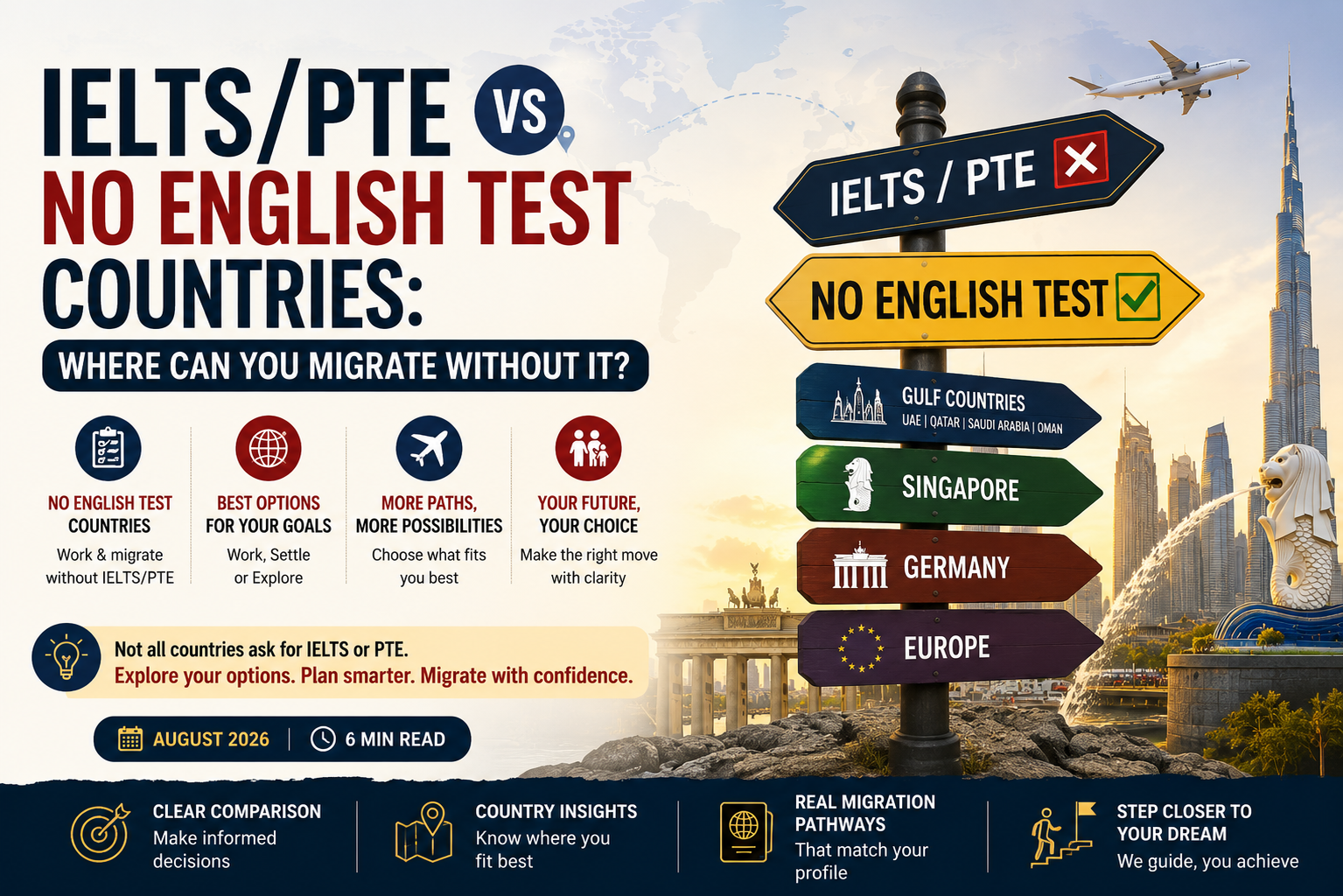
IELTS/PTE vs No English Test Countries
Where Can You Migrate Without It?
Talk to ten people who are trying to move abroad, and at least eight of them will bring up IELTS or PTE within the first two minutes. It's almost always the first hurdle people think about — sometimes even before they've picked a country.
And honestly, that makes sense. Maybe you've sat for IELTS twice already and your band score just won't move no matter how many practice tests you take. Maybe exams genuinely make you anxious, no matter how well you know the language. Or maybe you just don't have the extra money or three months right now to prepare for another test.
Here's the thing though — you don't always need one. There are real, legitimate countries that will let you in without IELTS or PTE. But before you get too excited, there's a catch worth understanding, and we'll get to that. Let's go through this properly.
Why Do These Tests Even Exist?
It's easy to feel like IELTS and PTE are just there to make life difficult. But step back for a second and look at it from the country's side.
If you're moving to Canada, Australia, the UK, or New Zealand, someone there is trusting you to:
- Do your job without constant miscommunication
- Talk to your team, your clients, maybe even your patients
- Handle everyday things — opening a bank account, renting a flat, seeing a doctor
The test is just their way of checking all that on paper, before you land. It's not personal. It's just paperwork standing in for a conversation they can't have with every single applicant.
Where You'll Still Need IELTS or PTE
If any of these four are on your list, there's no way around it — you'll need to sit for a test:
Canada — IELTS General or PTE Core, required for Express Entry and most PR routes.
Australia — IELTS or PTE Academic (or an equivalent), needed for skilled and most work visas.
United Kingdom — IELTS UKVI or PTE Academic UKVI.
New Zealand — IELTS or PTE, for skilled migrant and most work visa categories.
Not great news if you were hoping to skip it. But here's the silver lining — these are also the four countries with the strongest PR and long-term settlement options. So the effort you put into the test usually pays for itself down the line.
Where You Can Actually Skip the Test
Now for the part you're probably here for.
Gulf countries — UAE, Qatar, Saudi Arabia and the rest — are honestly the easiest route if English tests are what's holding you back. Employers there care much more about whether you can do the job than whether you have a certificate proving it. Most interviews happen straight in English, no formal score required.
Singapore works the same way for most work permit categories. There's no IELTS or PTE requirement — your English gets assessed informally, just through talking to the employer during the interview.
Germany and much of Europe — particularly Germany's Job Seeker Visa — also skip the English test requirement. The focus shifts to your job offer, your qualifications, and sometimes a basic grasp of German instead. Not English at all.
So if you're someone who just wants to start working abroad without spending months prepping for an exam, Gulf countries and Singapore are usually the fastest doors in.
The Catch: "No Test" Isn't the Same as "No English"
This is the part people skip past, and it trips them up later.
Just because a country doesn't ask for a certificate doesn't mean you can get by without speaking English at all. You'll still be expected to understand instructions at work, talk to your manager, and get through everyday situations on your own. No one's checking a score sheet — but they will notice in the interview, or on your first week at work, if you're struggling to communicate.
So think of "no test" as one less thing to prepare for, not a free pass to skip English altogether.
So Which One Should You Actually Pick?
There's no universal right answer here — it really comes down to what you want:
- If you're chasing PR, long-term settlement, or bringing your family over eventually, it's worth putting in the effort for IELTS or PTE and heading toward Canada, Australia, UK, or New Zealand.
- If you want to start working abroad soon, without the exam stress, Gulf countries or Singapore will get you moving faster.
- If you're open to picking up some German and want a strong foothold in the EU, Germany's job seeker route is worth a serious look.
Bottom Line
A low IELTS score, or the thought of sitting for another exam, doesn't have to be the reason your migration plans stay stuck. Some paths need the test. Others don't. Both are completely valid — it just depends on what you're chasing and how soon you want to get there.
The real question isn't "should I take IELTS or not." It's "which country actually fits what I want." Once that's clear, everything else — including the English test question — sorts itself out.
FAQ
Can I really get a work visa in the Gulf without any English test?
Yes. Most Gulf countries don't ask for IELTS or PTE for work visas. Your English usually gets judged during the interview itself, not through a certificate.
Is IELTS compulsory for every Canada visa category?
For most PR and skilled migration routes under Express Entry, yes — IELTS General or PTE Core is required. Some employer-specific or provincial pathways work a little differently, so it's worth checking your exact category before assuming either way.
Does Singapore need any proof of English at all?
Not usually, for most work permit categories. There's no formal test — employers judge your communication during the hiring conversation.
If I move to a no-test country now, will I still need one for PR later?
It depends on the country and the visa type. Some routes do ask for an English test if you later apply for PR or citizenship, even if it wasn't needed at the work visa stage. Best to ask about your specific pathway.
Which is easier, IELTS or PTE?
Honestly, neither is "easier" in general — it depends on you. PTE is computer-based and results come faster. IELTS has been around longer and a lot of people are more familiar with its format. Some people just naturally score better on one over the other.
I've failed IELTS before. What are my actual options now?
Two real paths: keep trying IELTS or PTE with better prep and see where the gap is, or look at no-test countries like the Gulf or Singapore and start working sooner. Neither is wrong — it comes down to what matters more to you right now.
Still Not Sure Which Country or Visa Route Fits You?
Talk to our team at Global Gateway Internationals — we'll help you figure out the right path based on your actual profile, not guesswork.